- Τηλεφωνικό Κέντρο: +30 2109649420
- Κινητό: +30 6974234231


Opus3records LP26001 B.B.Leon & Triple Treat “Blues Barn”
15 Δεκεμβρίου, 2020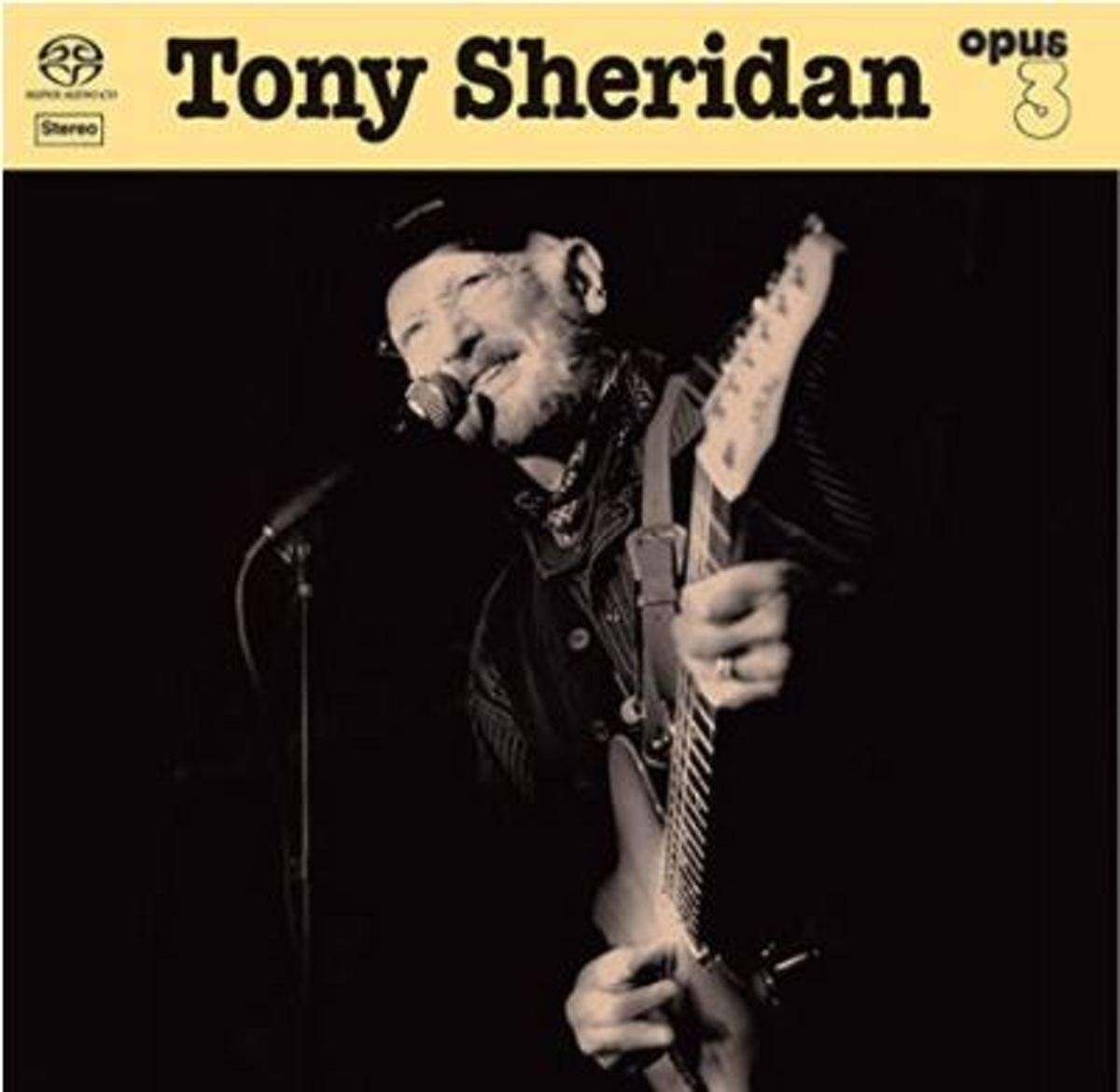
LP24001 Tony Sheridan and Opus 3 artists
16 Δεκεμβρίου, 2020


Opus3records Bottleneck John All Around Man LP 23001
35,00€

Bottleneck John All Around Man LP 23001All Around Man
It was by sheer coincidence we found Bottleneck John in September 2012 and for that we are very, very glad!
After a nice first meeting in my studio, everything was settled!
We had very similar ideas how to go about the album, and Bottleneck John made a great selection of songs and with a good variation.
On many tracks we also hear his blues brothers playing grand piano, Hammond organ, Wurlitzer, resonator & upright bass, percussion, fiddle, mandolin etc.
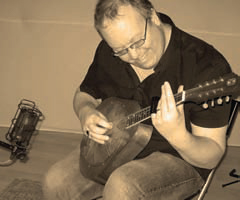
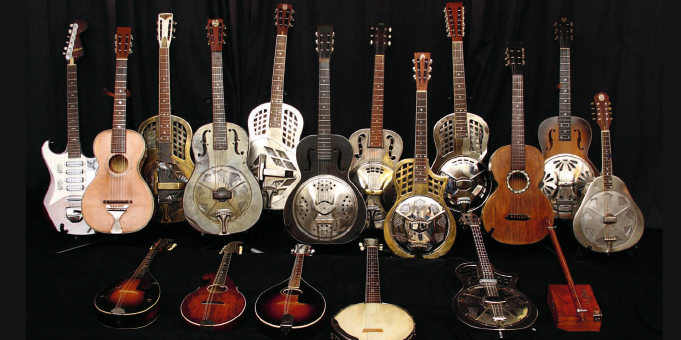
With a fantastic voice and great slide guitar playing on all his resonator guitars
This album is Bottleneck John´s debut on Opus 3 Records.
We are fortunate to have a very unusual and unique blues album, with so much authenticity and inspiration from the first half of the 20th century, when many legendary blues musicians were active.
| 01. Lonesome Valley (Trad.) |
2´25  |
08. All Around Man (Armenter Chatmon) |
3´08 |
| 02. Come On In My Kitchen (Robert Johnson) |
4´29 |
09. Walking In The Shadow Of The Blues (D. Coverdale / B. Marsden) |
4´42 |
| 03. No matter How She Done It (H. Wittaker / T. Dorsey) |
3´30 |
10. Mandolinferno (Johan Eliasson) |
3´18 |
| 04. Autumn Rime (Johan Eliasson) |
2´29 |
11. How Long, How Long Blues (Trad.) |
4´01 |
| 05. Do You Call That A Buddy? (Raye / Wilson) |
4´36 |
12. Only A Woman (Johan Eliasson) |
3´40 |
| 06. Jesus Gonna Be Here (Tom Waits) |
4´32 |
13. You Can´t Get That Stuff No More (H. Whittaker / T. Dorsey) |
3´36 |
| 07. Out Of The Rain (Tony Joe White) |
6´08 | 14. Wade In The Water (Trad.) |
3´52 |
Back in the summer of 1999 I first heard Eric Bibb’s album “Spirit & The Blues”, released on Opus 3 Records, and it totally and utterly changed the way I look upon and perform music.
Everything I did turned acoustic and I’ve stayed in the acoustic blues realm ever since.
I’d been singing the blues for a long time in electric settings and for me something illusive was missing. When I listened and searched back through the years I found my musical home in the old recordings from the late 1920’s and early 30’s.
The heart of my music is the genuine tone of resonator guitars, I just love the mechanically amplified sound.
Bottleneck John: Voice, 6 & 12-str. Resonator & Acoustic Guitars, Banjo, Mandolin, Electric guitar, Foot Stomp & Kazoo
Mattias Nordqvist: Grand Piano, Hammond Organ & Wurlitzer
Kent Ögren: Resonator & Double Bass
Lars Åstrand: Mandolin & Fiddle
Mattias Olofsson: Percussion
Stefan Swén: Harmonica
Karl Eneland: Tuba
Patrik Idell: Guitars
Vinyl 180 gram
About The Cutting Of LP’s
In response to many requests over the years since the release of Eric Bibb’s breakthrough album “Spirit & The Blues ” we are now pleased to make this and also “Good Stuff ” available on special 45 rpm double LP’s.
Since most complete CD’s are too long to be accommodated on a regular LP (33 rpm) it was necessary to produce a double LP, which in turn meant that advantage could be taken of the use of 45rpm. The main advantages of this is that it is possible to increase the cutting level thus reducing, in relative terms, the noise of the record. In addition the increased speed of rotation of the record gives improved high-frequency performance which is of particularly significance especially in the later parts of the record as the circumference progressively reduces.
We would also like to draw attention to the following:
A cutting lathe requires two signals, one feeding the cutter head and the other which gives information in advance to enable the grooves to be packed in the best possible way without impinging on adjacent grooves.
For this purpose a special tape recorder is required with one “preview” head for the spacing of the grooves and one audio head which feeds the cutter.
Between the heads the tape makes a special loop which provides the required delay. Because these very special tape recorders are becoming increasingly rare, many cutting studios have resorted to incorporating a digital delay in the signal path in order to use an ordinary tape recorder. This means that the audio signal in the record-groove has first been A / D converted, i.e. digitalized, then digitally delayed then D/A converted back to analogue. Such a vinyl record is therefore not truly analogue. Needless to say all Opus3 LP’s, are of course mastered in the old authentic way and are thus analogue all the way.
Discussions of sound nowadays tend to be very much preoccupied with the digital links of the sound reproduction chain, especially where gramophone recordings are concerned. Attention very often focuses exclusively on the type
of A/D converter used, how many bits, the amount of oversampling, how the equipment is specially modified, and so on and so forth.
When Opus 3 started at the end of 1976, there was far more talk about the way in which the actual recording was done purely in terms of recording technique or philosophy – that is, the methodology employed (multi- mike versus twin microphone technique etc.) and the type of recording situation chosen – natural environments or traditional studio technique, and so on.
Whatever the technical apparatus, it is still the actual, recording philosophy that does most to decide what a recording will sound like – a fact which has been virtually lost sight of in the discussion of sound today. The quantity of electronics used in a recording is also highly important. In the type of mixer consoles commonly used in a studio nowadays, the acoustic signal passes through a very large number of amplifier stages – between thirty and forty or more is not unusual! The Opus 3 electronics, which are mainly tube-equipped and which we have partly developed ourselves, seldom include more than three of four amplifier stages between microphone and storage medium.
Opus 3’s recording technique has been specially developed for acoustic music and is based on using the natural acoustics of authentic environments such as churches, concert halls, jazz clubs and so on. We match the venue to the music, so to speak, as opposed to the common studio practice of adding an artificial reverberation afterwards and so on. The positioning of the microphone in the recording room and the positioning of the musicians in relation to the microphone are also extremely important.
From the very outset we have used what is known as the coincident or X/Y recording technique, mainly employing the special configuration of crossed figure of eights, also known as the Blumlein technique, after Alan Dower Blumlein, the British radar engineer who developed the technique way back in 1934.
Depth of Image
So accustomed are we to three-dimensional vision, that we never really think about it. But we need only shut one eye for our judgment of distances to be reduced and our three-dimensional vision to disappear: we need both eyes and the relation between them in order for see three-dimensionally. Much the same is true of our hearing.
Our brain and auditory system “process” the sound-waves reaching each ear, with regard to level, direction, time and frequency content. The signal is further “analyzed” by our brain and auditory system, and the differences between signals coming from our two ears tell us, for example, about distance to the different sound sources and their relative positions. We experience “Depth of Image”: for example, the different instruments of the orchestra in a concert hall are differently placed, not only from left to right but also in depth, together with the size and acoustics of the concert hall.
By “collecting” the total sound at one single point with a stereo microphone -that is,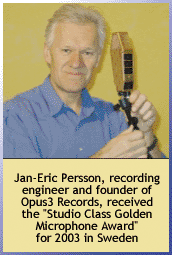 a microphone with its capsules as close together as possible -we obtain a strict relation between the direct sound and the reflected sound (the diffused sound field), and this gives our brain and auditory system important information for building up an illusion of “reality” – the concert hall, the church or the jazz club. It is also very important for the direct and the reflected sound to have an exact acoustic connection with the sound-waves from each instrument. In traditional recording studios, there is, basically, one microphone (or sometimes even more) per instrument, and these are then mixed together electrically. This is not real stereo, it is just panned mono.
Since, moreover, the microphones are usually placed veryclose to each instrument in an acoustically dead studio, all one gets is the direct sound of the instrument, and so artificial reverberation has to be “added on” electrically afterwards.
Timbre
By timbre we mean the specific character of an acoustic musical instrument – meaning, for example, what makes it possible for us to tell one instrument from another. The timbre of a musical instrument is a combination of its significant spectral distribution, i.e. the relation between notes and their harmonics and each relative level and frequency distribution, and last but not least, the way in which the sound-waves radiate from the body of the instrument.
All our acoustic instruments are designed to be played in some form of concert hall, i.e. in a place where you hear both the direct sound of the instrument and the reverberation of the environment. If, like Opus 3, you are aiming for as natural an instrumental timbre as possible, it is vitally important that acoustic instruments can also be recorded in the type of surroundings they were originally designed to be played in, but also with longer microphone distances, so as also to capture the sound radiating from the whole sounding body of the instrument. The short microphone distances normally used also make the timbre unnatural, and so it has to be “restored” artificially, using various equalizers etc. We mustn’t forget that when our acoustic musical instruments were created, a long time ago, neither electricity, microphones or recording studios existed !
Dynamics
The dynamic range of a musical instrument is the difference between the loudest and the softest sound level it is capable of producing. Like timbre, the dynamics of a musical instrument depend, not only on how it is built but also on how it is used by the composer and performer. Dynamics in this sense are used to create a large number and variety of musical effects, changes of emotion, mood and expression etc., etc. The dynamic properties of a musical instrument are also very much affected by the way in which it is recorded. The short microphone distances used for multi-microphone recording in traditional studios also exaggerate the recorded dynamics. Just like timbre, the dynamic balance then has to be artificially “restored”, using compressors, limiters and so on.
| Weight | ,4 kg |
|---|
Εταιρία
Opus3 Records


