- Τηλεφωνικό Κέντρο: +30 2109649420
- Κινητό: +30 6974234231


OPHIDIAN MINIMO 2 Τιμή ζεύγους.
8 Απριλίου, 2023
KerrAcoustic K 200 Τιμή το ζεύγος χωρίς τις βάσεις.
9 Απριλίου, 2023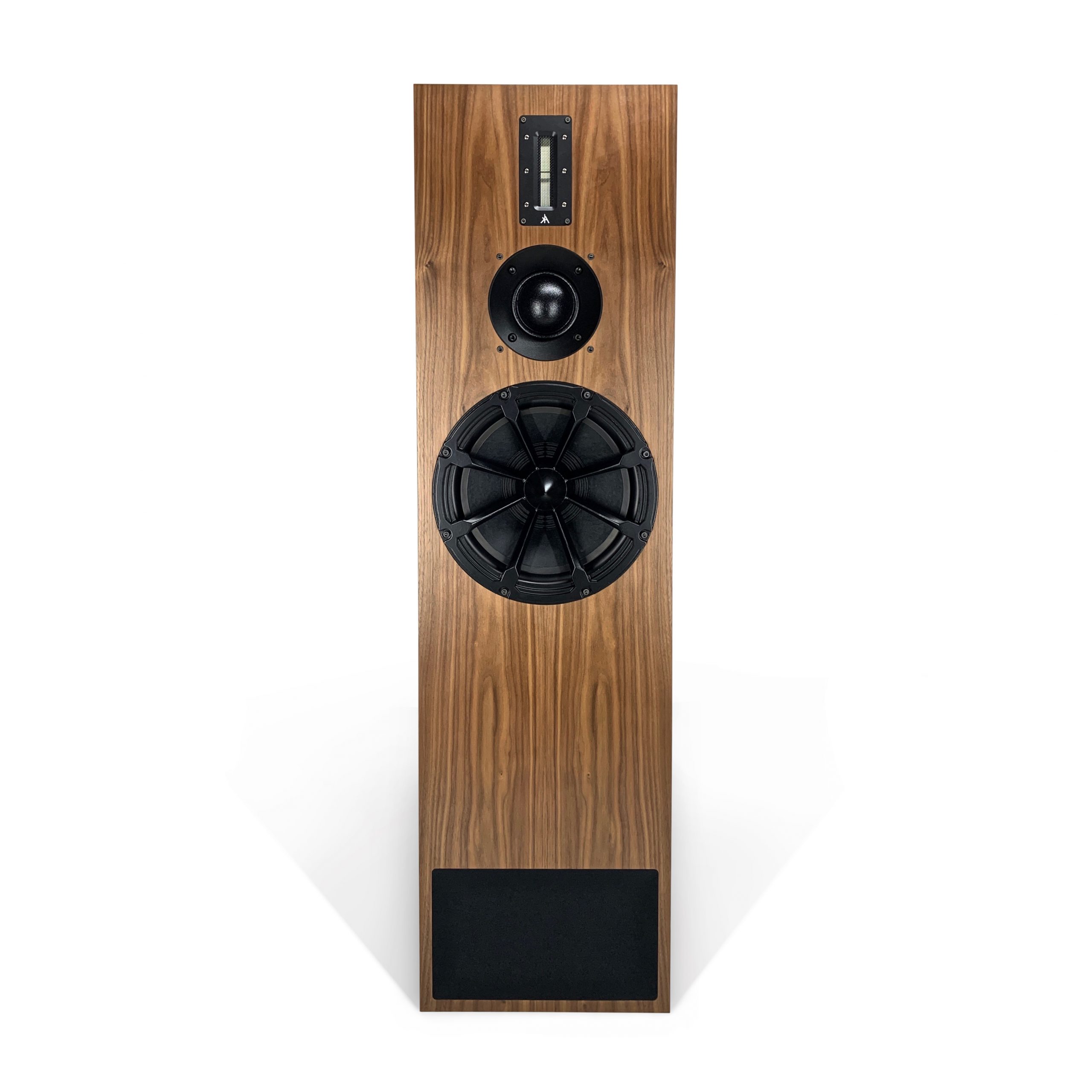


kerr Acoustic K100 MK II REFERENCE Τιμή το ζεύγος.
32.000,00€

kerr Acoustic K100 MK II REFERENCE Τιμή το ζεύγος.
Our reference loudspeaker – the K100 is a large format three-way design, featuring a twelve-inch Radial™ woofer partnered with a three-inch dome and true ribbon tweeter. Offering an uncompromised frequency response from 16Hz to 45kHz, the K100 is a true reference monitor, designed to set the new standard in professional monitoring and critical listening.
Whether you require a truly compromise-free accurate monitoring solution in your mix/mastering studio, or the ultimate reproduction of fine detail in your personal system, the K100 guarantees a truly accurate and fully extended sonic performance. Constructed exclusively from 24mm Baltic Birch Plywood, the K100 is capable of effortlessly reproducing any program material with total ease and accuracy. The strength and rigidity of the cabinet construction, combined with cutting-edge driver technology allows for uncoloured and vivid musical playback at all listening levels.
The mk.2 update brings significant improvement to the internal passive crossover networks, providing a smoother and more linear response throughout the upper midband and high frequencies. This allows the K100s to convey an even greater sense of depth and spacial information, whilst simultaneously reducing glare and listener fatigue.
Available in a range of real wood veneer finishes, including Oak, Walnut, Rosenut and Black Oak, as well as either satin or high-gloss lacquer in any RAL colour.
Supplied with magnetic grilles and threaded M8 spikes as standard.
LF Driver 310mm High-Performance long-throw unit with Radial™ intercooler technology
MF Driver 75mm Low-distortion dome with 8 kg magnet assembly
HF Driver 80mm True Ribbon tweeter with 0.036g diaphragm mass
Response 16Hz – 45kHz
Sensitivity 91dB (2.83V/1m)
Impedance 8 Ohms (nominal)
Crossover 370Hz | 3.6kHz – 2nd order (12dB/ Octave)
Dimensions H:1268 | W:348 | D:550 mm
Construction 24mm Baltic Birch plywood transmission-line
Weight 78 kg (per cabinet)
Connections One pair of 4mm copper 5-way binding posts
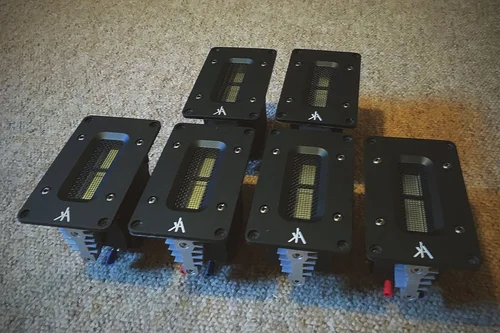
We feel that ribbon tweeters are an area often shrouded by misconception. While the term ‘ribbon’ is used to cover a broad range of tweeter technologies, a ‘True Ribbon’ tweeter is one in which the whole diaphragm itself acts as the conductor. This means there is absolutely zero excess (non-conducting) mass, and that the diaphragm can be immensely thin and light.
The aluminium ribbon diaphragms used in our K300 monitor are just 15 microns thick, and have a total moving mass of 0.027g.
For context, air-motion-transformer tweeters typically have a moving mass of 0.17g, and conventional dome tweeters around 0.5g. From this, you can gather that our ribbons are approximately eighteen times lighter than most domes!
The result? Flawless reproduction of high-frequency content, and unmatched transient response. The speed, extension, and non-fatiguing detail that our tweeters provide is quite remarkable, and make it very hard to switch back to conventional tweeter designs.
We are proud to use Volt Loudspeakers in our K100 reference monitors. In a speaker system designed to work entirely without compromise, only the finest drivers will do, which is why we choose Volt.
The K100 features a 12” high-performance Radial™ driver with intercooler technology, and a 3” soft dome with 8kg magnet assembly. The combination of these drivers alongside our 3” True Ribbon results in truly unprecedented frequency response and extension.
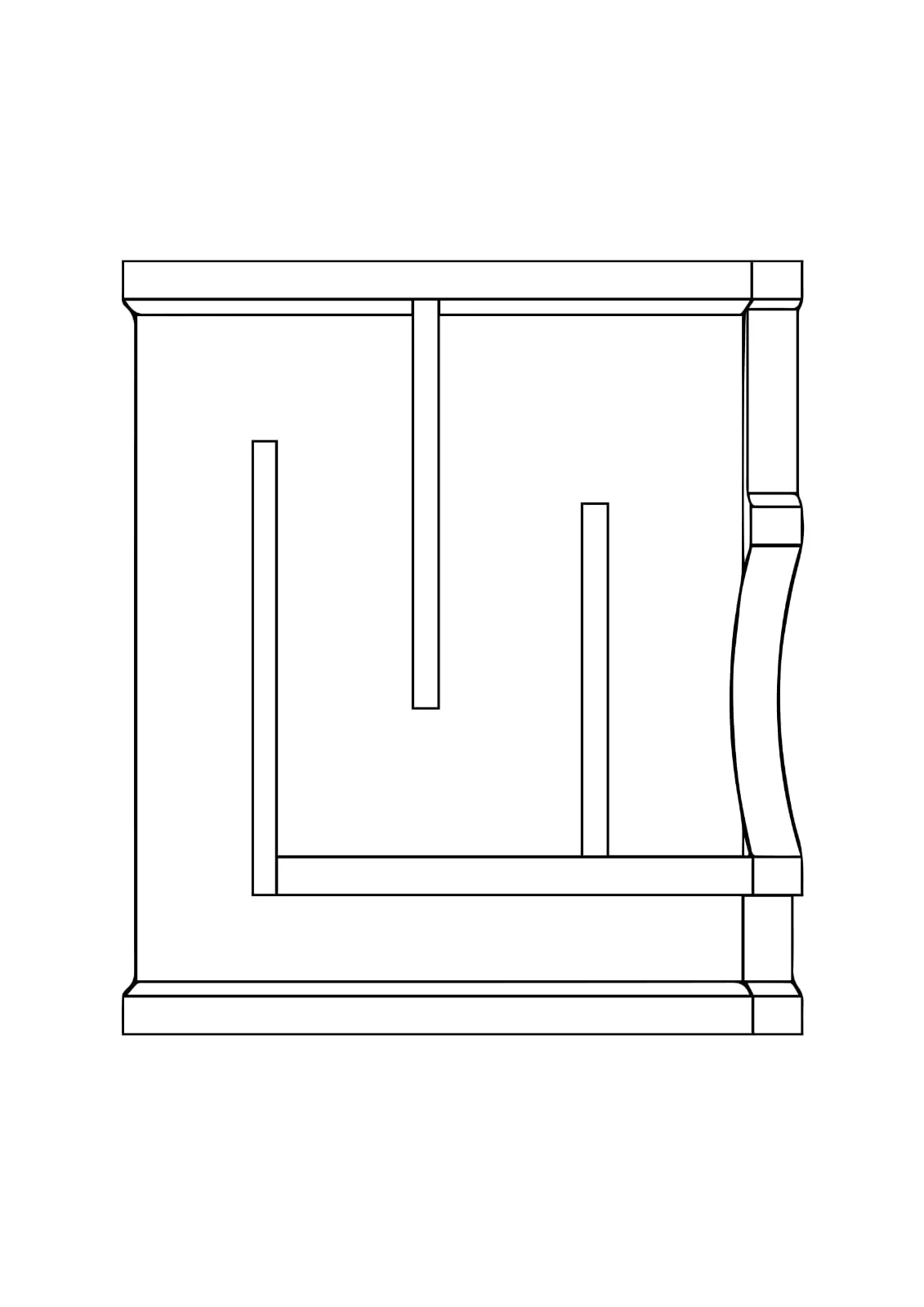
KERR ACOUSTIC TRANSMISSION LINE
Based on quarter-wave technology, the Kerr Acoustic transmission line represents a breakthrough in frequency response and extension. We have carefully refined every detail of our transmission lines, to ensure exceptionally well-controlled and extended bass, and clear uncoloured midrange. The resultant performance truly belies the physical size of our speakers, bringing remarkable sonic reproduction into your space.
CROSSOVER WITHOUT COMPROMISE
We firmly believe that a crossover network can make or break a loudspeaker design, which is why we consider the quality of these circuits to be of the utmost importance. Using bespoke hand-wound air-core inductors, and the highest quality pair-matched film capacitors and resistors, our crossovers are kept utterly neutral and transparent. Each crossover is hand-assembled on our custom PCB boards. and individually measured before being installed. We use pure OFC copper internal wiring in each loudspeaker, and feature high-quality 5-way copper binding posts.

TRUE RIBBON TWEETER
Whether you’re a professional mix engineer who requires surgical precision when creating music, or a discerning audiophile who wishes to hear every nuance when listening for pleasure, the true ribbon tweeter delivers unprecedented clarity and resolution. Once you become accustomed to listening with this level of precision and detail without fatigue, you’ll never switch back to a conventional tweeter.
BALTIC BIRCH PLYWOOD
The physical loudspeaker cabinet is arguably the most fundamental component in any speaker design, whilst simultaneously being one of the most overlooked. We place a great emphasis on the materials and construction quality of our cabinets, taking every possible measure to eliminate unwanted resonance. Each cabinet we produce is handcrafted from the highest grade responsibly-sourced Baltic birch plywood. The 90-degree alternating cross-grain makeup of our plywood allows us to create panels which are entirely self-damping and acoustically inert. As a result, our cabinets are extremely strong and rigid, and transfer minimal levels of mechanical energy into their surrounding environment. When compared with cabinets made from MDF and other less costly alternatives, the difference in performance is starkly clear.
STUNNING CUSTOM FINISHES
Our finishing options are of the very highest quality, and guarantee your loudspeakers to be a stunning addition to any space. It’s no secret that while sonic performance is the ultimate goal, aesthetics play a large role in the ultimate enjoyment of your loudspeakers, and that in many cases you may wish for your loudspeakers to fit into a pre-existing setting. Using the RAL colour system, we are able to match to over 200 different colours in automotive-grade polyester lacquer, in either satin or high gloss finishing options. We also offer a range of sumptuous real wood veneer finishes, with customisation available upon request.

Transmission Lines and Ribbon Tweeters: The Best Route to Loudspeaker Design for Accurate Musical Reproduction
General Introduction
The professional music and consumer electronic industry has strived for decades to optimise loudspeaker design for time response, frequency response, dynamic and timbral accuracy within the constraints set by cost, size, and positioning limitations. Bass response has historically presented inevitable trade-offs in terms of low frequency extension and control, as well as cabinet size and drive current requirements. Equally, advancements in electrostatic, planar magnetic and orthodynamic headphone technologies have highlighted the less-than-perfect nature of high frequency reproduction from most typical loudspeaker systems. Recent developments in ribbon tweeter technology, combined with a revised approach to bass-frequency reproduction through the refinement of transmission line technology, allow a designer to tackle some of the fundamental limitations of loudspeaker design and sound reproduction, resulting in a level of absolute sonic accuracy as well as a cost/performance ratio that has been previously unavailable.
INTRODUCTION TO TRANSMISSION LINE PRINCIPLE AND SONIC BENEFITS
An acoustic transmission line is essentially a tuned labyrinth (or ‘rear waveguide’) that begins directly behind the main low-frequency driver in a speaker system, and gradually tapers until it reaches its terminus – which typically has a surface area equal to the cone of the driver. Depending on the format of the enclosure, this labyrinth will consist of a number of internal folds to allow the desired line length to be achieved. In smaller designs, this line length can be decreased in conjunction with a reduction of the area of the terminus to achieve similar effects, with the compromise of losing some extension and overall output. In the truest sense, a transmission line would consist of an infinitely tapering chamber, which in practice is a physical impossibility. To this extent, the term is partially misused, and acoustic ‘transmission lines’ work on the basis of being tuned to 1/4 or 1/3 of the wavelength of the resonant frequency of the driver, and are heavily damped with absorptive material. The output from the terminus greatly reinforces content below 80Hz, with the unwanted higher frequencies from the rear of the driver being absorbed by the internal dampening.
The compromises associated with transmission-line designs include a cabinet size that is often larger than typical sealed or bass-reflex enclosures. Furthermore, transmission line speakers have historically been considered ‘low efficiency’ designs, which require more power to achieve the desired output level. In addition, the cabinets are highly complex to design effectively, and equally complex to manufacture. The advantages offered by transmission line designs include a dramatically improved extension in the low-frequency range when compared to sealed/reflex designs, and a far more gradual ‘roll-off’ in this region. In addition, the definition and accuracy of the bass is greatly improved, and midrange response is far purer and less coloured by distortion. This is as a result of unwanted energy being directed away from the cone, removing the non-linear distortion that often occurs in sealed or reflex enclosures. In such enclosures, this distortion typically occurs as a result of the unwanted, rearward directed energy resonating and reflecting inside the cabinet, and either exiting via a port (in the case of reflex enclosures) or reflecting back through the cone itself, introducing non-linear behavior and colouration.
Kerr Acoustic has devoted significant research and development time to harness the benefit of transmission lines, addressing their inherent drawbacks to create designs optimally tuned for maximum acoustic performance. This has allowed us to greatly increase efficiency, and to achieve clean and accurate low frequency response extending all the way down to 33Hz, in the case of our stand-mount K300 speakers. With the recent advances in this technology, the sonic benefits of transmission lines must be matched by improved performance in the definition and time response of other components in the loudspeaker system. This is particularly true of the tweeter, which handles the bulk of the critical information we perceive when listening to music. One important consideration is the Fourier transform limit – an important principle of physics that governs a variety of technologies (including optical communications) which dictates that the time response of a system is always limited by its frequency response. Hence, use of a large bandwidth tweeter would not only add additional high-harmonic content and spatial information clues to the sound of speaker, but it would also allow a much faster time response. This is an ideal way to preserve, enhance and complement the fast and accurate bass response of transmission line designs.
Further reading in relation to the history and physical principals of transmission line loudspeaker technology can be found at the following resources:
- Quarter-wavelength loudspeaker design – Martin J King – http://www.quarter-wave.com
- Classic transmission-line design – Jon Risch – http://www.t-linespeakers.org/design/classic.html
INTRODUCTION TO RIBBON TWEETERS – A NEW OPPORTUNITY FOR INNOVATIVE SPEAKER DESIGNERS
An effectively incorporated transmission line offers the most frequency-complete and time- accurate bass response. This calls for the use of true ribbon tweeters, with their extended frequency response and ultra-fast time response. Ribbon tweeters are another area shrouded by some misconception. While planar tweeters are not uncommon, true ribbon tweeters are rarely featured in ‘affordable’ products, and the term ‘ribbon’ is often misused to describe the majority of planar tweeter designs on the market. The most commonly seen planar tweeters consist of a folded plastic film or membrane, which has a conductor either weaved into the material, or bonded to the material’s surface. This assembly is suspended within a strong magnetic field, and is technically classed as an ‘air-motion transformer’ design. Typically the resultant response is faster and better extended than most dome tweeters, though arguably more ‘abrasive’, particularly when used over long periods of time. This effect is chiefly responsible for listener fatigue, and is the primary reason that they are considered a compromise – particularly in the professional field. In a true ribbon tweeter, the diaphragm is itself the electrical conductor, and is made from an ultra-thin strip of conductive material (typically aluminum). This guarantees that there is no excess mass whatsoever – the only moving mass being the conductor itself. However this solution comes with some additional complexity and cost. While most planar tweeters present similar impedance and sensitivity characteristics compared to dome designs, true ribbon tweeters must incorporate an impedance-converting transformer to match the amplifier and crossover impedance to that of the diaphragm. This impedance matching is essential to allow proper function of a ribbon tweeter, due to the nature of alternating current flowing directly through the large conductor.
Further reading in relation to the physical principals and different functional types of tweeter technology can be found at the following resource:
How Speakers Work: Understanding the Differences in Tweeter Technology – Electronics House – https://www.electronichouse.com/how-to/understanding-differences-in-tweeter-technology/
The sonic benefits of using true-ribbon tweeters are clear: they offer a time response and a level of high-frequency reproduction unmatched by other designs. One of the key factors here is the physical mass of the diaphragm/conductor, which is typically just 20-30 microns thick and can weigh as little as 20 milligrams (compared to a typical 170 milligram air- motion-transformer tweeter, and around 0.5 grams for a conventional dome). As an example, the ribbon tweeter diaphragm featured in our K300 model weighs 0.027 grams, and has an effective surface area of 720 square millimeters. For comparison, most conventional domes have a 700 square millimeter radiating surface area, but on average have a moving mass that is eighteen times greater.
This incredibly low mass allows for a uniquely fast response, which is crucial for accurate reproduction of the very highest frequencies. Ribbon tweeters are therefore purported to possess an extremely airy and transparent sound, owing to the absence of voice-coil inductance, linear magnetic field, and extremely low diaphragm mass. Again, the Fourier transform principal is highly relevant to the reason why the perceived sonic presentation from ribbon tweeters is so aurally preferable over alternate technologies.
Historically, these designs have been prohibitively expensive to implement into cost- effective, competitively priced products, and have included compromises including low power handling and reliability issues. Equally, their off-axis response has been historically regarded as inferior to dome designs, owing to the rectangular shape of the diaphragm. The performance and cost related issues have been addressed by a recent breakthrough in design and manufacturing processes, that has made the technology suitable for high-quality, non-prohibitively expensive ribbon tweeters. This is largely as a result of having improved manufacturing tolerances, and far greater access to a wider range of precision tooling for construction, assembly, and testing. Off-axis response has been greatly improved through a combination of ribbon surface corrugation, and incorporation of diffractive and reflective elements within the tweeter enclosure.
Despite this tremendous progress, the process of designing a loudspeaker that fully exploits the benefits of ribbon tweeters and accounts for their residual idiosyncrasies is not trivial, and requires acute balancing of the accompanying components, and very careful crossover management. Ultimately, if one can design a system that fully exploits the benefits of ribbon tweeters, whilst simultaneously managing their behavioral characteristics, they represent the very best in tweeter technology available today. When combined with transmission line technology, they have the potential to unleash unprecedented frequency extension and time response, leading to the most accurately defined reproduction of harmonic content, dynamics, spatial information and – most importantly – timbre, available.
• How Speakers Work: Understanding the Differences in Tweeter Technology – Electronics House – https://www.electronichouse.com/how-to/understanding-differences-in-tweeter-technology/
HOW ARE KERR ACOUSTIC SPEAKERS DIFFERENT?
Kerr Acoustic has capitalized on the previous absence of a loudspeaker system that fully exploits the combined benefits of transmission lines and ribbon tweeters, while mitigating all the sonic and practical drawbacks that have been associated with such technologies in the past. We have tackled this challenge according to the following design principals:
- Efficient, transparent, low-loss crossover networks – for ease of drive and dynamic integrity.
- Frequency and time response accuracy for absolute transparency and fidelity, in both studio and domestic applications.
- Insensitivity to boundary conditions and linear off-axis response, for maximum flexibility with positioning.
- Robust and acoustically inert cabinets for minimal colouration and maximum stability.
APPROACH TO LOUDSPEAKER DESIGN
During the intricate design process, a combination of precise acoustic measurement and tuning by ear is employed in an effort to produce loudspeakers with highly linear frequency and time responses. While acoustic measurement is considered an important factor, great emphasis is placed on constant, critical aural assessment throughout design and fine-tuning of the products. An extensive benchmark is offered by designer Jes Kerr’s personal ownership of and experience in listening to a vast number of loudspeakers, spanning every conceivable technology and design topology available. This is reinforced by extensive experience in the fields of musical performance and production, and regularly being in the presence of acoustic instruments and voices in their inception. In addition, Kerr Acoustic has extensive in-house knowledge of bespoke joinery, which allows for extremely cost-effective and time-efficient development and manufacture of new cabinet designs. Below we expand on the methodology behind our approach to design, and explain how each point of differentiation listed above is facilitated and addressed.
CROSSOVER NETWORKS
Our crossover networks are extremely efficient and sonically transparent, owing to the use of exceptionally high quality components and intuitive design. High-grade polypropylene capacitors are used in conjunction with hand-wound air-core inductors and carbon-film resistors. This combination allows for outstanding component synergy and drive-unit integration, fully optimizing the output bands for each drive-unit without negatively affecting their efficiency or adding a sonic footprint. Extensive comparison and testing of different components has been carried out here, in a focused effort to design the most efficient and effective crossover networks. Other considerations include ensuring that components are able to withstand high-level current peaks without losing linearity or saturating, which is vital for ensuring that transients are preserved and reproduced accurately during dynamic program material. This is a common theme that extends to the drive units also, ensuring that signal peaks will not introduce distortion or damage components. Tolerances are very carefully measured and components are pair-matched for each pair of speakers produced. A detailed record is kept of the exact component values featured in each pair of loudspeakers sold, in the unlikely event of component failure and subsequent servicing being required. With this method, an overall tolerance of less than 1% can be achieved in any given pair of loudspeakers we produce.
INSENSITIVITY TO BOUNDARY CONDITIONS
A combination of factors including a front-firing transmission-line terminus, and very low levels of unwanted energy transfer (owing to cabinet rigidity) result in a loudspeaker that is particularly unfussy with regards to physical placement. While all loudspeakers benefit from being placed in an acoustically treated environment, experience has shown that our speakers exhibit great versatility with regards to their integration in different settings. The excellent off-axis response also lends itself to flexibility in this regard.
ROBUST AND ACOUSTICALLY INERT CABINETS
All Kerr Acoustic loudspeakers are crafted from the finest grade Baltic Birch plywood, which is renowned for naturally being strong and dependable as a material. This plywood consists of a sandwich composite of 1mm thick layers (or ‘plys’) of birch wood, with an alternating grain pattern that rotates 90 degrees between each ply. Resin is used to bond these layers during high-pressure, high temperature formation, and this in conjunction with the 90- degree grain rotation results in a remarkably strong and acoustically inert, low-resonance material. Through applying an iterative approach to manufacture, employing outstanding attention to detail and maintaining fine tolerances throughout assembly, our enclosures are sonically optimised for maximum performance and minimal colouration across the entirety of each loudspeaker’s frequency range.
THE RESULTS
The end result of this methodical and fastidious approach to design and manufacture is a loudspeaker system that performs quite unlike any other. Their response delivers the accuracy and neutrality required for critical studio monitoring, whilst simultaneously employing the transparency, speed and resolution to make them desirable for high-end domestic application.
When in the presence of Kerr Acoustic speakers, listeners can expect to bear witness to uncannily realistic reproduction of well-recorded sources. Particularly in the case of the smaller models, the response and extension belies the physical cabinet size in quite an extraordinary fashion, with a far greater sense of scale and dynamics than would typically be associated with loudspeakers of comparable size, cost and format.
All musical genres are used in the extensive trialing and fine-tuning process for the products, ranging from classical and baroque recordings, through modern electronic compositions, contemporary rock, pop and urban selections, to experimental music and field recordings. Both analogue and digital mediums are used throughout this process.
TIPS FOR BEST PERFORMANCE
For best performance, the loudspeakers should be partnered with the highest quality ancillaries and partnering components possible, regardless of power. By their nature, our loudspeakers are highly revealing of up-stream components, and will expose any weaknesses in a given signal chain. If being listened to for pleasure, the highest quality sources available should be employed. The shortcomings of compressed digital formats are greatly highlighted by Kerr Acoustic speakers, and therefore should be avoided wherever possible.
While our products will benefit greatly from being partnered with amplifiers that have stable power supplies and high damping factor, they have a greater-than-average sensitivity rating, and do not present any particularly difficult impedance loads. To this extent, they can be partnered with a broad range of different amplifier topologies, from multiple hundred watt solid-state amplifiers, to 5-8W single-ended vacuum tube amplifiers. Our speakers will consistently deliver stunningly natural dynamics and frequency response. Obviously, a greater sense of scale and dynamics will be available when partnered with designs with high current stability, that have sufficient headroom to allow for accurate reproduction of dynamic peaks in the program material. As with all frequency and time-accurate components, our speakers will be extremely revealing of the quality of the amplifier used.
Optimal positioning / placement includes ensuring that the tweeters are roughly at ear level, and that the speakers should be positioned almost parallel to one another, with very minimal toe-in. This configuration generally has shown to produce the most accurate and vivid soundstage in a variety of settings.
Product Purchased: K300
“At least 15 different models and makes of speakers have transited through my system in the last 30 years. These have included the likes of Sonus Faber, Opera, B&W, Mordant Short, Electro Voice, Infinity and many more. Speakers turnaround was rather high, until I stumbled in the Audio Note AN-Js, an updated version of the old and glorious design by the late Peter Snell. For 15 years, a pair of AN-Js has proven unbeatable in combination with a 10W AudioNote single-ended valve amplifier. Several attempts to upgrade speakers (or even the whole speaker plus amplifier combination) have proven futile. The AN-Js always won hands-down.
That was until I heard the Kerr Acoustic K300s. To my surprise, here was a pair of transmission line speakers that not only were very efficient and valve friendly, but also – for the first time – significantly improved the sound of what I still consider a near perfect system. Simply put, once I heard music through the K300s, most other speakers seemed compromised, their skilfully tuned trade-offs suddenly becoming less acceptable.
“…they make any music sound as real and exciting as a live performance…
So what did I find so special about the K300? In a nutshell, it is all about their neutrality: neutrality as accuracy in frequency response, which is incredibly flat and extended at both ends of the spectrum; but also neutrality as accuracy in time response. Combined, these two aspects of the K300 make for precise timbre reproduction as well as grin-inducing macro and micro-dynamics. The purity and cohesion that spans the mid-bass to high frequency range allow the K300 to reproduce everything – from strings to voices, from brass to drum skins – in the most natural and realistic way. The astonishingly deep bass, completely free from any overhang, gives unbelievable scale and kick to music. The ribbon tweeters build on the immaculate bass depth and control to produce transients and attacks that have lighting speed. All this is achieved without a hint of harshness or unnatural emphasis on the high frequencies. This is quite extraordinary and something that I have not found in any other speaker (and not just in the price range of the K300s). Usually, fast speakers tend to lack harmonic richness and body, ending up sounding lean and forward. Not the K300s.
My diet of music is extremely varied – from jazz to classical, from old and indie rock to heavily processed electronic music. The K300 do justice to any genre of music. In fact, they don’t just do justice, they make any music sound as real and exciting as a live performance, while highly processed or electronic music sounds simply propelling and so mesmerisingly layered. My personal sonic highlights of the K300s include their ability to separate kick drum from double bass in any jazz piano trio; the way kettle drums are suddenly revealed in their pitch as well as power out the mass of orchestral sounds in any romantic symphony; how sung words in voices become so intelligible and yet emotionally involving; the way the shimmer and the decay of all sorts of crash and cymbals are no longer blurred and homogenised, but crystal clear and individually characterised. The absence of “mid-bass pollution” also means ultimate midrange purity and glorious synth sounds in electronic music such as Kraftwerk. Talking of which, their Minimum Maximum live recording of Man Machine, at around 2 minute in the track, projects some 30Hz sounds that you won’t believe can project so pure and powerful from the small K300s cabinets – the magic of their perfectly tuned transmission lines!
“The K300 are the easiest speaker to place in any environment – I have yet to find a position that compromises their sound.
Something else worth sharing is that music from vinyl (free of tracking distortion, courtesy of my inexpensive and UK-made tangential arm) has reached new peaks of pleasure and realism, with so much detail, ambient information and amazingly clean and hard-hitting bass. I just can’t get enough of it. Fortunately for my stylus, digital music has also become way more engaging since adopting the K300s. My attempts at reducing jitter have been precisely guided by the monitor-like nature of the K300s and, like a surgeon looking through a high-resolution viewer, I have been able to tune digital sound reproduction to a completely new level of accuracy and naturalness .
Just as I thought that music could not get any better than played through the K300s driven by my 10W AudioNote valve amp, I discovered that the K300s sound also wonderful, in a different but equally spectacular way, when driven by an old school 100W Japanese amplifier from the 80s (Pioneer, Technics, Sony). And by the way, the K300 are the easiest speaker to place in any environment – I have yet to find a position that compromises their sound.”
– Claudio M.
Product purchased: K300
“Firstly, the aesthetics. Before I even fire them up, everyone has commented on how good they look in the stock grey finish, particularly on the Custom Design FS 104 stands with optional larger top plate. So pleased we decided to err from the norm of veneer boxes in the lounge, we think these look great especially in a contemporary room.
From our previous transmission lines these are a massive improvement, the detail and weight of sound is stunning coming from a relatively small enclosure, the true ribbon tweeter seems to offer lovely smooth highs with no hint of harshness yet has the ability to claw huge detail out of the mix.
The bottom end of these speakers is just sublime, I love that almost characteristic transmission line low “thump” that many other high end speakers don’t seem to offer.”
– Andy Elsegood
Product Purchased: K300
“I bought a pair of K300 speakers to replace my floor-standers, and this is a summary of my experience in the first month of ownership. I had previously seen and heard them at a show, so I already knew how they sounded in a far from ideal performance space, and I was fairly confident that they would be fine in my over-furnished living room.The really nice thing for me is that the K300 is already showing that freedom from being boxed-in, and they look so good.
The speakers’ room-friendly design has made them very easy to place – I’ve put them close to and perpendicular to the rear wall, so they are aligned nicely with the existing furniture. I tried them in a more conventional arrangement but didn’t notice much difference. I’ve listened to a variety of music and A/V sound and the most apparent strength is their clarity, so the notes are edgy and not muddied or boxed in. For example, I’ve listened to a large orchestral piece on FM and had no doubt about whether the underlying bass riff was being supplied by drums or by double basses being plucked or being bowed. With the A/V I’ve now been caught out twice thinking a noise has come from elsewhere in the house.
I’m really happy with the breadth and balance of the sound I’m getting from the various sources that they have to handle. The bass is so nicely controlled and I think the top end has come in a bit more since the initial experience. I really am a very happy customer and am now thinking of upgrading my cartridge to match the superior sound.”
– Julian Coates
Product Purchased: K300
“From the first time I listened to these fabulous speakers, the Kerr Acoustic K300s grabbed my attention with a spectacular, well-defined timbre and texture. The sound is simply astonishing and magical.
The balance and integration of the frequencies is far better than that of thousands of top-quality three-ways speakers. All frequencies are very well integrated and cohesive, yet extremely accurate and precise, with exquisite resolution.
The woofer is very fast with a rich, deep and agile bass response. The tweeter well focused and precise, even at the very highest frequencies.”
– Claudio Barbieri
Product Purchased: K300
“I am fond of classical music (from ensembles and concertos to symphonies and operas), tango and jazz. Starting as a hifi beginner, I had the Ruark Icon and Castle Durham 3. Then the T+A Criterion bookshelf. There were a few years when I got tired of the local hifi scene due to certain obvious commercial reasons.
Recently I have decided to look for a new pair of speakers with greater analytical capability and, especially, bass plunge. So the quest began. For second hand and unused items, I auditioned MBL311E, Dali Helicon 300 and Transmission Audio M1i. Just the M1i could impress me by the sound positioning and high frequencies. And I was determined to get a pair of speakers with ribbon tweeters.
By good chance now proven to be sheer enchantment, I read of Kerr Acoustic and their manufacturing statements. So I made up my mind to give the K300s a try.
Upon setting up, I played my favourite Viveza Tango Tango and Brahms’s First. The result was purely stunning. The high notes are smooth and the bass is defined and strong. Clarity and positioning are superb too. I wonder how they have achieved this with such small but longer than usual cabinets. The 6.5” woofer is generous given the size. The quality and solidness of the cabinets and finish could also be felt easily.
The front ports are also one of the factors which prompted the purchase as my listening area isn’t too big. Well thus is normally Hong Kong.
– W. Tsang
| Weight | 90 kg |
|---|---|
| Dimensions | 600 × 400 × 1400 cm |
Εταιρία
Kerr Acoustic